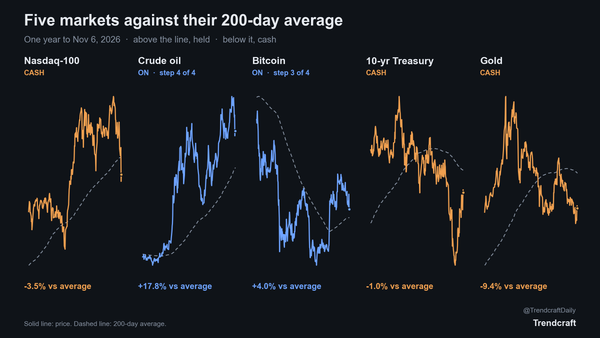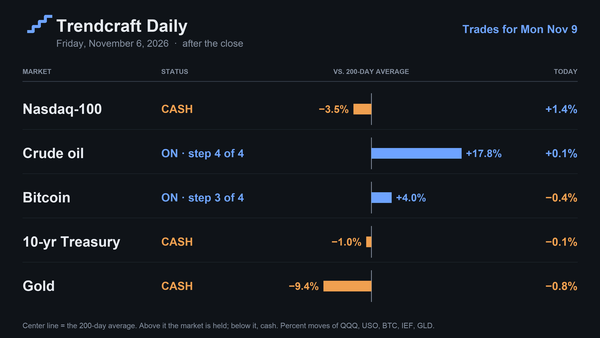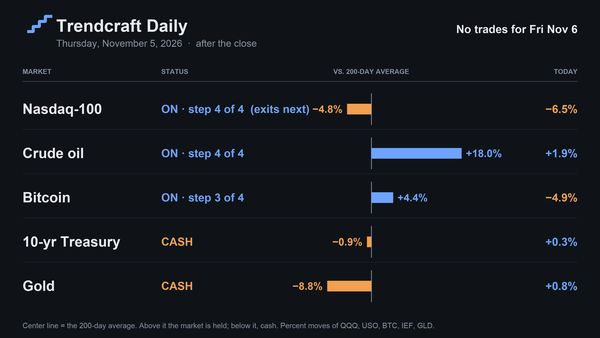
No changes. Every market holds where it is.
Nothing changes for Thursday. Keep the model portfolio as it stands.
What to do for Thursday
- No trades. Every target is the same as in the last issue.
- No change: Nasdaq-100 (QLD) at 41.1%, Crude oil (UCO) at 19.2% and Bitcoin (BITX) at 11.5%.
- In cash: the 10-year and gold.
Trade calculator: download the spreadsheet, type in your cash and the shares you own, and it works out each buy and sell for your account.
Your targets for Thursday, Oct 29
| Fund | Market | Hold | Last issue | What to do | On a $10,000 account |
|---|---|---|---|---|---|
| QLD | Nasdaq-100 | 41.1% | 41.1% | Hold | $4,108 |
| UCO | Crude oil | 19.2% | 19.2% | Hold | $1,918 |
| BITX | Bitcoin | 11.5% | 11.5% | Hold | $1,146 |
| UST | 10-yr Treasury | 0.0% | 0.0% | None | $0 |
| UGL | Gold | 0.0% | 0.0% | None | $0 |
| Cash | 28.3% | 28.3% | $2,827 |
Hold is the share of your account to keep in each fund, by dollar value, after the trades. The last column shows what that means on a $10,000 account; scale it to yours. The targets add up to less than 100% of the account, so nothing is borrowed and the margin and cash versions are the same today. At full size, each market gets fewer dollars the more it tends to swing, so each one adds about the same risk to the account.
How the rules work
Each market is either on or in cash. It's on while its price is above its average closing price of the last 200 trading days, and goes fully to cash when it closes below that average. Once on, it builds in four steps: it starts at a quarter of its full size and adds a quarter each time the price climbs another average daily range above where it started. The signals use the plain markets (QQQ, GLD, USO, IEF and bitcoin); the positions are held in 2x funds that move about twice as much each day. Full rules are on the Methodology page.
Signal board
| Market | Tracks | Last close | 200-day average | Distance | Steps | Next step at |
|---|---|---|---|---|---|---|
| Nasdaq-100 | QQQ | 725.61 | 677.55 | +7.1% | 4 of 4 | all 4 in |
| Gold | GLD | 373.51 | 413.54 | −9.7% | in cash | in cash |
| Crude oil | USO | 166.57 | 123.02 | +35.4% | 4 of 4 | all 4 in |
| 10-yr Treasury | IEF | 90.85 | 92.53 | −1.8% | in cash | in cash |
| Bitcoin | BTC | 81,502 | 73,377 | +11.1% | 3 of 4 | 85,965 |
What to watch
- Nasdaq is the closest to an exit, 7.1% above its average. A close below about $677.82 on QQQ moves it to cash.
- Bitcoin is $4,462 from step 4. A close at or above about $85,965 adds step 4.
- Gold is in cash, 9.7% below its average. A close above about $413.50 on GLD starts a new entry.
- The 10-year is in cash, 1.8% below its average. A close above about $92.53 on IEF starts a new entry.
How to use this letter
- Trade during the next session. Change a holding only when its target moves or it drifts more than 5% of your account away from target.
- The margin version needs a margin account with at least $2,000. If you don't use margin, follow the cash version.
- Your own taxes, account size and risk tolerance matter. This letter can't take them into account.
About this publication. Trendcraft is published after every U.S. market close. It is the same for every subscriber and is not personalized investment advice. The publisher does not manage, trade or access subscriber accounts.
Publisher's positions. When the publisher holds the model portfolio's positions in a personal account, they are traded only after each issue is sent. The publisher never trades ahead of readers.
Risk. The model uses 2x leveraged ETFs and, in the margin version, borrowed money. Leveraged funds lose value in volatile, sideways markets, and a broker can sell positions without notice in a margin call. Losses can be large and fast. Model and hypothetical results are not actual trading and do not guarantee future results.