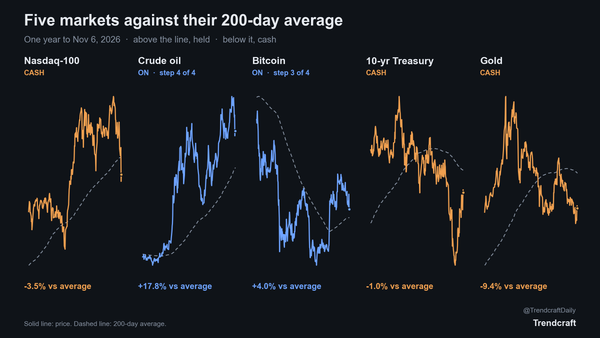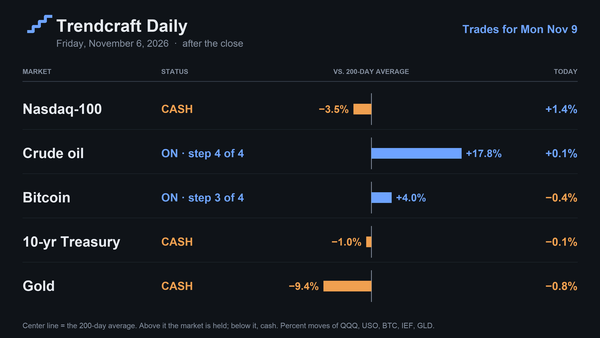
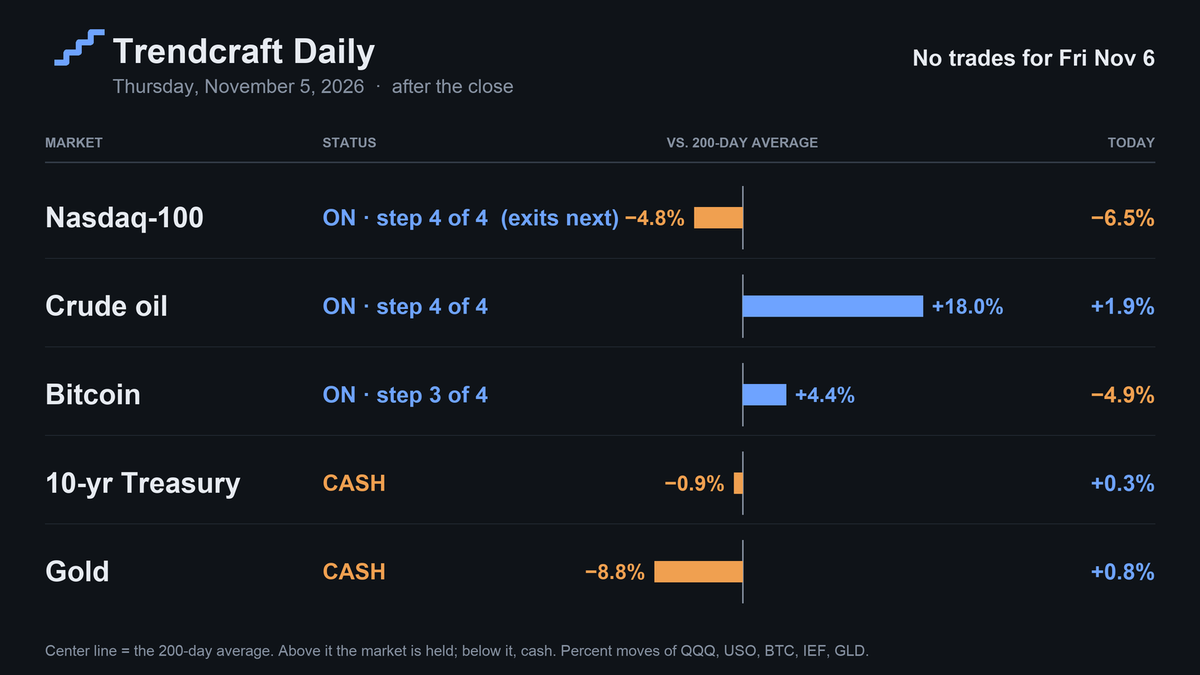
No trades for Fri Nov 6. Nasdaq closed below its average and exits in Friday's issue.
Nothing changes for Friday. Keep the model portfolio as it stands.
Today: Nasdaq −6.5%, oil +1.9%, bitcoin −4.9%, the 10-year +0.3%, gold +0.8%. The model portfolio is −12.7% since the first issue on Oct 19 (hypothetical, after modeled costs; track record).
What to do for Friday
- No trades. Every target is the same as in the last issue.
- No change: Nasdaq-100 (QLD) at 41.1%, Crude oil (UCO) at 19.2% and Bitcoin (BITX) at 11.5%.
- In cash: the 10-year and gold.
Trade calculator: use it on the web (enter what you hold, it lists the trades), or download the spreadsheet, type in your cash and the shares you own, and it works out each buy and sell for your account.
Your targets for Friday, Nov 6
| Fund | Market | Hold | On a $10,000 account |
|---|---|---|---|
| QLD | Nasdaq-100 | 41.1% | $4,108 |
| UCO | Crude oil | 19.2% | $1,918 |
| BITX | Bitcoin | 11.5% | $1,146 |
| UST | 10-yr Treasury | 0.0% | $0 |
| UGL | Gold | 0.0% | $0 |
| Cash | 28.3% | $2,827 |
Hold is the share of your account to keep in each fund, by dollar value, after the trades. The last column shows what that means on a $10,000 account; scale it to yours. The targets add up to less than 100% of the account, so nothing is borrowed and the margin and cash versions are the same today.
New here? The rules in plain words, and what to do if you're starting mid-trend, are on the Methodology page.
Signal board
| Market | Tracks | Vs. 200-day average | Steps | Next step |
|---|---|---|---|---|
| Nasdaq-100 | QQQ | −4.8% | 4 of 4 | all 4 in |
| Gold | GLD | −8.8% | in cash | in cash |
| Crude oil | USO | +18.0% | 4 of 4 | all 4 in |
| 10-yr Treasury | IEF | −0.9% | in cash | in cash |
| Bitcoin | BTC | +4.4% | 3 of 4 | 14.2% higher |
What to watch
- Nasdaq closed below its 200-day average today. Under the rule it goes to zero in Friday's issue, whatever Friday's close; today's target holds for Friday's session.
- Bitcoin is the closest to an exit, 4.4% above its average. A close about 4.3% lower moves it to cash.
- Bitcoin is 14.2% from step 4. A close about 14.2% higher adds step 4.
- Gold is in cash, 8.8% below its average. A close about 9.6% higher starts a new entry.
- The 10-year is in cash, 0.9% below its average. A close about 0.9% higher starts a new entry.
How to use this letter
- When to trade: any time during Friday's session. The model's results assume the trades were made at today's close, which no reader can do, so your prices will differ a little. When the rules were tested, trading one day later made no meaningful difference to the results.
- When to change a holding: only when its target changes, or when it has drifted more than 5 percentage points away from its target. Otherwise leave it alone. Example: QLD's target is 41.1%. If a rally has grown it to 46.6% of your account, sell back down to 41.1%.
- Margin or cash: the margin version borrows to hold more than 100% of your account; the cash version holds the same mix without borrowing. If you don't use margin, follow the cash version. A margin account needs at least $2,000 under FINRA rules, and many brokers ask for more. Each broker also sets its own margin requirement for 2x funds, often higher than for ordinary stocks, so check yours. Today nothing is borrowed, so the two versions are the same.
- Your situation: this letter is the same for every reader. Your taxes, account size and how much loss you can live with are yours to weigh.
Past issues · Track record · Methodology
About this publication. Trendcraft is published after every U.S. market close. It is the same for every subscriber and is not personalized investment advice. The publisher does not manage, trade or access subscriber accounts.
Publisher's positions. The publisher follows the model's cash version with real money in two brokerage accounts and places those trades only after each issue is sent. The publisher never trades ahead of readers.
Risk. The model uses 2x leveraged ETFs and, in the margin version, borrowed money. Leveraged funds lose value in volatile, sideways markets, and a broker can sell positions without notice in a margin call. Losses can be large and fast. Model and hypothetical results are not actual trading and do not guarantee future results.